Attendance Policy Template for Indian Small Businesses (Free to Copy)
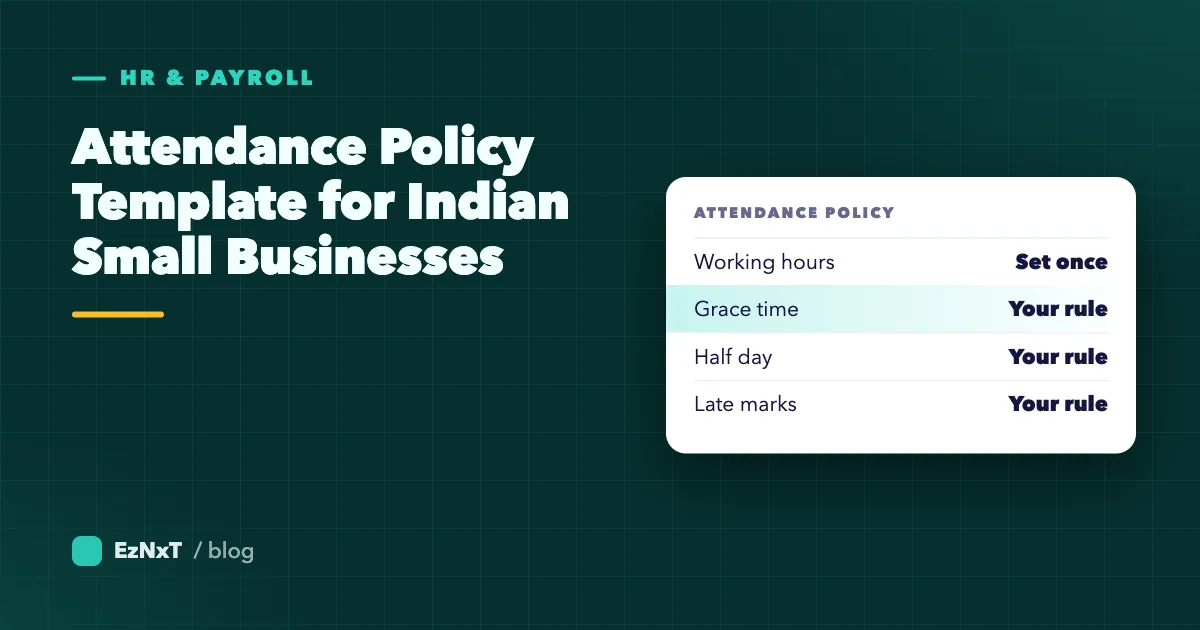
Quick answer: an attendance policy template should define working hours and shifts, how attendance is recorded, the grace period, how late marks and half days are counted, how missed punches are regularised, overtime approval and pay, and the consequences of repeated violations. Copy the template below and adjust the numbers to your business and state rules.
Without a written policy, attendance decisions get made case by case: one manager forgives three late arrivals, another cuts a half day. That inconsistency is what employees resent most. A short, clear policy, applied by the system rather than by memory, solves it.
What an attendance policy should cover
| Section | Decide |
|---|---|
| Working hours and shifts | Start and end time, break, weekly off, shift rotation |
| How attendance is recorded | Biometric, mobile app, web check-in, or manager marking |
| Grace period | Minutes allowed after shift start before a late mark |
| Late marks and half days | How many late marks equal a half day; minimum hours for a full day |
| Regularisation | How to fix a missed punch, who approves, by when |
| Overtime | Prior approval, how hours are recorded, pay rate |
| Remote and field work | How attendance is marked outside the office |
| Absence without notice | Notification rules and when it becomes unpaid leave |
Attendance policy template (copy and edit)
1. Purpose and scope. This policy applies to all employees of [Company Name], including probationers and fixed-term staff, from [effective date].
2. Working hours. Standard hours are [9:30 am to 6:30 pm], Monday to [Friday/Saturday], including a [60]-minute break. Shift employees follow the roster published by their manager at least [7] days in advance.
3. Recording attendance. Employees must mark attendance at the start and end of each working day using [biometric device / EzNxT app / web check-in]. Field and remote employees mark attendance through [the mobile app].
4. Grace period and late marks. A grace period of [10] minutes applies. Check-in after the grace period is a late mark. [Three] late marks in a calendar month are treated as [one half day] of leave.
5. Half day and full day. Fewer than [4] working hours is treated as a half day; fewer than [2] hours is treated as absent, unless approved.
6. Regularisation. Missed or incorrect punches must be regularised within [3] working days with a reason, and approved by the reporting manager.
7. Overtime. Overtime must be approved in advance by the reporting manager and recorded in the attendance system. Eligible employees are paid overtime as required by applicable law.
8. Absence. Employees must inform their manager before the start of the shift if they cannot attend. Unauthorised absence for [3] consecutive days may lead to disciplinary action.
9. Review. HR reviews this policy every year and communicates changes in writing.
Legal points to check before you publish
- Hours and overtime limits come from the Occupational Safety, Health and Working Conditions Code and your state’s Shops and Establishments rules. Overtime is generally paid at twice the ordinary rate of wages. Confirm the daily and weekly limits that apply to your establishment.
- Women working night shifts may need consent and safety arrangements under state rules.
- Salary deductions for absence must follow the Code on Wages; a late-mark rule should convert to leave or loss of pay for actual absence, not arbitrary fines.
- Records: keep attendance and overtime registers, because inspections and PF/ESI calculations rely on them.
Make the policy work in practice
- Configure the same grace period, late-mark and half-day rules in your attendance system, so nobody calculates them by hand.
- Send the policy to every employee and record acknowledgement at onboarding.
- Review the monthly late-mark report with managers before payroll cut-off.
- Link attendance to leave and payroll. Read how to run payroll in India and our leave policy template.
EzNxT’s attendance tracking software handles shifts, biometric and mobile attendance and half days, and passes paid days to payroll.
Frequently Asked Questions
What is a reasonable grace period for late coming?
Ten to fifteen minutes is common in Indian offices. Whatever you choose, apply it the same way to everyone and configure it in the attendance system.
Can an employer deduct salary for late coming?
Deductions must follow the Code on Wages. A policy that converts repeated late marks into leave or loss of pay for actual time not worked is safer than fixed fines. Confirm with your legal adviser.
How many late marks make a half day?
There is no legal number. Many companies use three late marks in a month as one half day. Choose a rule, put it in writing and apply it consistently.
Should remote employees follow the attendance policy?
Yes. Define how remote and field staff mark attendance (for example a mobile app check-in) and what counts as working hours for them.
How often should an attendance policy be reviewed?
At least once a year, and whenever labour rules, shifts or working arrangements change.
Building your HR basics? See HRMS for small business.