How to Calculate In-Hand Salary From CTC (With a Worked Example)
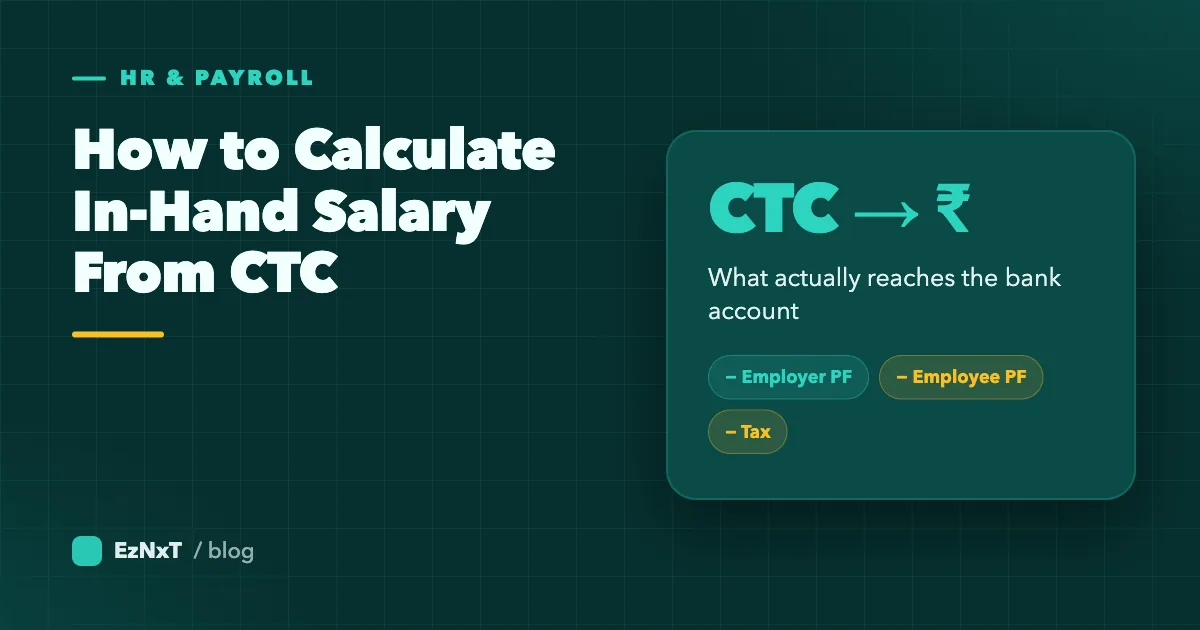
Quick answer: to work out in-hand salary from CTC, first remove the costs the employer pays on top of salary (employer PF, gratuity provision, insurance) to get gross salary. Then subtract the employee’s own deductions (employee PF, professional tax, employee ESI if applicable, and income-tax TDS). What remains, divided by 12, is the monthly take-home.
Offer letters in India almost always quote CTC, cost to company, because it is the largest number. Employees care about the amount that actually reaches their bank account. The gap between the two surprises new hires every year, so it is worth explaining with real numbers before an offer goes out.
CTC vs gross salary vs in-hand salary
| Term | What it includes | Who sees it |
|---|---|---|
| CTC | Gross salary + employer PF + gratuity provision + other employer-paid benefits | Offer letter, budget |
| Gross salary | Basic + HRA + allowances, before any employee deductions | Payslip (top line) |
| In-hand (net) salary | Gross salary − employee PF − professional tax − employee ESI − TDS | Bank account |
How to calculate in-hand salary from CTC, step by step
- Split CTC into monthly components. Divide annual CTC by 12, then list basic pay, HRA and allowances. Under the new Labour Codes, wages (basic + DA) should be roughly half of total remuneration. See our guide to the Labour Codes and the 50% wage rule.
- Remove employer-only costs. Employer PF (12% of PF wages, often capped at ₹15,000 wages), the gratuity provision (commonly budgeted at 4.81% of basic) and any insurance premium the company pays are part of CTC but never reach the employee each month.
- Subtract employee PF. 12% of PF wages. See how PF is calculated for the ceiling rules.
- Subtract employee ESI if covered. 0.75% of gross wages, only when gross is ₹21,000 a month or less. See ESI applicability and rates.
- Subtract professional tax. A state tax capped at ₹2,500 a year; most states that levy it charge up to ₹200 a month.
- Subtract TDS. Income-tax deducted each month based on the tax regime the employee chooses and their projected annual income.
Worked example: ₹6 lakh CTC
Illustrative structure for a monthly CTC of ₹50,000, with basic at 50% of CTC and PF contributed on the ₹15,000 wage ceiling. Professional tax is taken at ₹200 a month.
| Component | Monthly (₹) |
|---|---|
| Monthly CTC | 50,000 |
| − Employer PF (12% of ₹15,000) | 1,800 |
| − Gratuity provision (4.81% of ₹25,000 basic) | 1,203 |
| = Gross salary (basic 25,000 + HRA 10,000 + special allowance 11,997) | 46,997 |
| − Employee PF (12% of ₹15,000) | 1,800 |
| − Employee ESI (not applicable: gross above ₹21,000) | 0 |
| − Professional tax | 200 |
| − TDS (nil at this income under the new regime, see note) | 0 |
| = In-hand salary | 44,997 |
So a ₹6 lakh CTC becomes roughly ₹45,000 a month in hand: about 90% of monthly CTC. On the new tax regime, annual taxable salary here is well below the level at which the rebate brings income-tax to nil (₹12 lakh of taxable income for FY 2025-26). Always check the slabs for the current financial year on the Income Tax Department’s website.
What changes the in-hand number most
- PF on actual basic instead of the ₹15,000 ceiling. If PF is calculated on the full ₹25,000 basic, employee PF rises from ₹1,800 to ₹3,000 and in-hand falls by ₹1,200, while long-term savings rise by the same amount.
- A higher basic share. Raising basic inside a fixed CTC increases PF and gratuity, which lowers take-home.
- Tax regime choice. Under the old regime, HRA exemption and deductions can change TDS significantly.
- Variable pay. Performance bonuses included in CTC are paid only if earned, so they are not part of the monthly in-hand.
How to explain it in an offer letter
Add a one-page annexure with the monthly breakup above: CTC, gross, each deduction and the expected in-hand amount. It prevents first-payslip surprises and early resignations. EzNxT’s free offer letter generator and salary slip generator help you share the breakup in a consistent format.
Frequently Asked Questions
Is in-hand salary the same as net salary?
Yes. In-hand, take-home and net salary all mean gross salary minus the employee’s deductions (PF, ESI, professional tax and TDS).
What percentage of CTC is in-hand salary?
For most salaried employees it is roughly 70% to 90% of CTC. It depends on the basic pay share, whether PF is on the ceiling or actual basic, and how much income-tax applies.
Is gratuity part of CTC?
Many employers include a gratuity provision in CTC, but it is paid only when the employee becomes eligible, typically after five years of continuous service, or after one year for fixed-term employees under the Labour Codes. It does not appear in the monthly in-hand salary.
Does employer PF reduce my in-hand salary?
Not directly. Employer PF is paid on top of gross salary, but because it is included in CTC, a CTC-based offer with a larger employer PF leaves less room for gross salary.
How can I check my in-hand salary quickly?
Ask for the monthly salary breakup, then subtract employee PF, professional tax, employee ESI (if gross is ₹21,000 or less) and the monthly TDS estimate from gross salary.
Running payroll for your team? Read how to run payroll in India or see EzNxT payroll software.