What Is a Sales Pipeline? Stages, Example and a Free Template
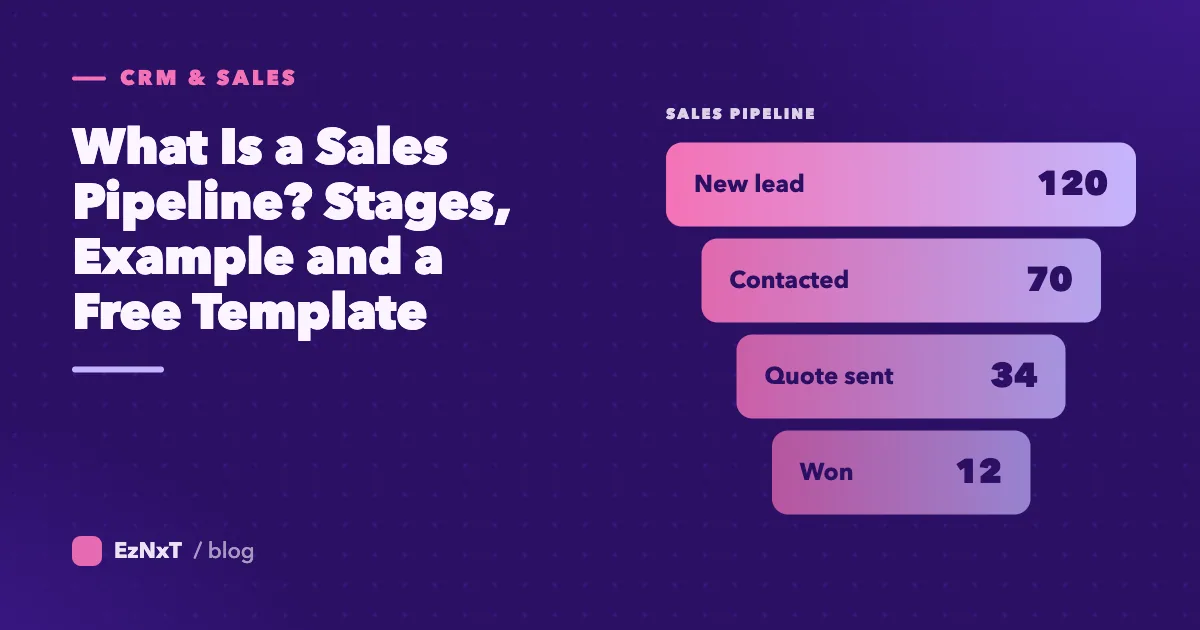
Quick answer: a sales pipeline is the set of stages a potential customer moves through, from first contact to a won or lost deal, with every open deal placed in its current stage. It shows how much business is in progress, where deals get stuck, and what revenue you can expect. Most small teams use five to seven stages.
Without a pipeline, sales is a list of names and a feeling about how the month will go. With one, you can see that twelve deals are waiting for a proposal, three have gone quiet for two weeks, and the month needs four more wins.
Typical sales pipeline stages
| Stage | What it means | Exit criteria |
|---|---|---|
| 1. New lead | Enquiry received, not contacted yet | First conversation done |
| 2. Contacted | Spoke or replied; need understood | Budget, need and decision-maker confirmed |
| 3. Qualified | A real opportunity worth pursuing | Demo or meeting held |
| 4. Proposal sent | Quote or proposal shared | Feedback or negotiation started |
| 5. Negotiation | Terms, price, timeline being agreed | Verbal yes or a clear no |
| 6. Won / Lost | Deal closed either way | Invoice raised, or loss reason recorded |
Name stages after what the buyer has done, not what the salesperson hopes. “Proposal sent” is a fact; “Very interested” is not.
A worked sales pipeline example
A 3-person B2B team selling an annual service at an average deal size of ₹60,000:
| Stage | Deals | Typical win chance | Weighted value (₹) |
|---|---|---|---|
| Qualified | 20 | 20% | 2,40,000 |
| Proposal sent | 10 | 40% | 2,40,000 |
| Negotiation | 5 | 70% | 2,10,000 |
| Total | 35 | 6,90,000 |
Weighted value = deals × average deal size × win chance. Use your own historical win rates once you have a few months of data; the percentages above are only an illustration.
Four sales pipeline numbers to track
- Conversion rate per stage: what share of deals moves to the next stage. A sharp drop shows where to fix the process.
- Average deal size: total won value ÷ number of won deals.
- Sales cycle length: average days from new lead to won.
- Pipeline velocity: (open opportunities × average deal size × win rate) ÷ sales cycle length in days, which gives the revenue the pipeline produces per day.
Sales pipeline template
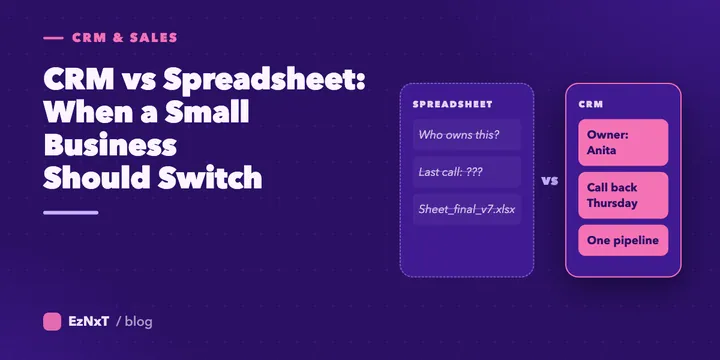
Start with these columns, whether in a CRM or a sheet: deal name, company, contact, owner, stage, deal value, expected close date, next step, next follow-up date, source and loss reason. The next follow-up date is the column most teams skip and most deals die without. Read CRM vs spreadsheet to decide where to keep it.
Keeping the pipeline honest
- Every open deal has an owner and a next follow-up date.
- Deals with no activity for 30 days are reviewed: revive or close as lost.
- Record a loss reason on every lost deal; patterns show what to fix.
- Review the pipeline weekly as a team, stage by stage.
More on capturing and qualifying leads in how to track sales leads and lead management software.
Frequently Asked Questions
What is a sales pipeline in simple words?
A visual list of all open deals, arranged by stage from first contact to closing, so you can see what is in progress and what needs attention.
How many stages should a sales pipeline have?
Five to seven is enough for most small businesses. Too many stages make updating the pipeline a chore; too few hide where deals get stuck.
What is the difference between a sales pipeline and a sales funnel?
A pipeline tracks individual deals and the actions your team takes at each stage. A funnel shows how many prospects convert from one stage to the next, usually as percentages.
How do you calculate pipeline value?
Add up the value of open deals. For a more realistic forecast, multiply each deal’s value by the win probability of its stage and add the results (weighted pipeline value).
Can a small business manage a sales pipeline without a CRM?
Yes, with a well-structured spreadsheet for a small number of deals. A CRM helps once several people sell or follow-ups start slipping.
See EzNxT CRM, or start with free CRM software for India.