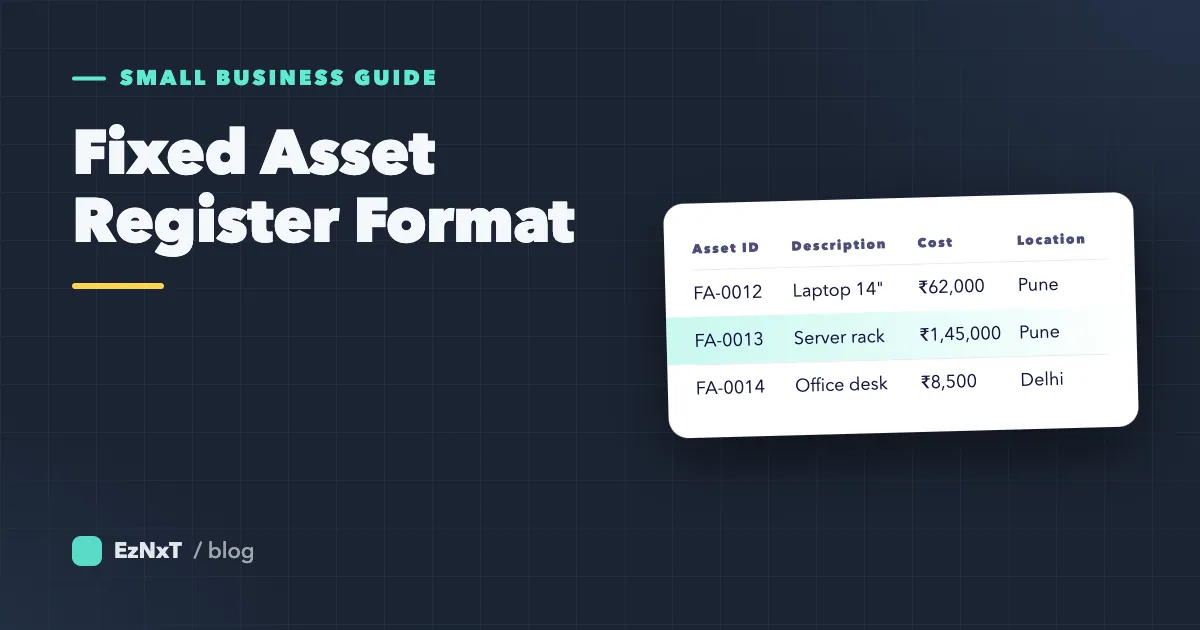
Fixed Asset Register Format: Columns, Example and Depreciation Rules
Quick answer: a fixed asset register format lists every long-term asset with its ID, description, category, location, custodian, purchase details and cost. It also records the date the asset was put to use, its useful life, the depreciation method and rate, accumulated depreciation, closing book value, disposal details and the last physical verification date. One row per asset, updated whenever an asset is bought, moved, repaired or sold.
A fixed asset register (FAR) is what your auditor asks for first, and what most small businesses keep last. Without it, laptops leave with ex-employees, depreciation is guessed at year-end, and insurance claims stall for lack of proof. Here is the format to use.
Fixed asset register format: the columns to keep
| Group | Columns |
|---|---|
| Identification | Asset ID / tag number, description, category (block), serial number |
| Location and custody | Location / branch, department, assigned employee |
| Purchase | Supplier, invoice number and date, cost (excluding GST credit claimed), other capitalised costs |
| Use | Date put to use, useful life, residual value |
| Depreciation | Method (SLM or WDV), rate, opening value, depreciation for the year, accumulated depreciation, closing value |
| Control | Warranty / AMC expiry, last maintenance, last physical verification date and condition |
| Disposal | Date, sale value, profit or loss on disposal |
Sample entry
| Field | Example |
|---|---|
| Asset ID | FA-0024 |
| Description | Laptop, 16 GB RAM, serial 5CD12345 |
| Category | Computers (end-user devices) |
| Assigned to | Sales team, Bengaluru office |
| Cost | ₹60,000 (input GST claimed separately) |
| Date put to use | 1 April 2026 |
| Useful life / method | 3 years, straight line, residual 5% |
| Depreciation for FY 2026-27 | ₹19,000 ((60,000 − 3,000) ÷ 3) |
Useful lives under the Companies Act (Schedule II)
| Asset type | Useful life | Income-tax WDV rate |
|---|---|---|
| Computers and laptops (end-user devices) | 3 years | 40% |
| Servers and networks | 6 years | 40% |
| Office equipment | 5 years | 15% |
| Furniture and fittings | 10 years | 10% |
| Motor cars | 8 years | 15% |
| General plant and machinery | 15 years | 15% |
Companies depreciate in their books using Schedule II useful lives (residual value is generally up to 5% of cost), while income-tax depreciation uses block-wise WDV rates. If an asset is used for less than 180 days in the year of purchase, only half the tax depreciation is allowed. Many businesses track both in the same register. Confirm rates with your CA for your asset classes.
SLM vs WDV in one example
For the ₹60,000 laptop: straight-line method (SLM) gives ₹19,000 every year for three years. The written-down value method (WDV) at 40% gives ₹24,000 in year 1, ₹14,400 in year 2 and ₹8,640 in year 3, front-loading depreciation.
Physical verification and audit
- Verify assets physically at least once a year; auditors of companies report on it under CARO 2020.
- Tag every asset with a QR code or barcode so verification is a scan, not a hunt.
- Record assignment and return whenever an employee joins, moves or leaves. Read moving from Tally to cloud accounting to keep the asset ledger in step with your books.
Frequently Asked Questions
What is a fixed asset register?
A record of every long-term asset a business owns, with its cost, location, custodian, depreciation and disposal details. It supports the fixed assets figure in the balance sheet.
Is a fixed asset register mandatory?
Companies must maintain proper records of fixed assets, and auditors report on them under CARO 2020 where it applies. For other businesses it is strongly recommended for depreciation, insurance and audits.
Can I keep a fixed asset register in Excel?
Yes, for a small number of assets. Once assets are spread across locations or assigned to many employees, asset tracking software keeps assignment history and depreciation up to date.
How often should a fixed asset register be updated?
Whenever an asset is bought, moved, reassigned, repaired or disposed of, and depreciation should be posted at least at each year-end.
What is the useful life of a laptop under the Companies Act?
Three years, as an end-user device under computers and data processing units in Schedule II. Servers and networks have a useful life of six years.
See EzNxT Asset Tracker and connect it to EzNxT Accounting & Books.