ESI Applicability and Rate: Who Is Covered and How Much to Pay
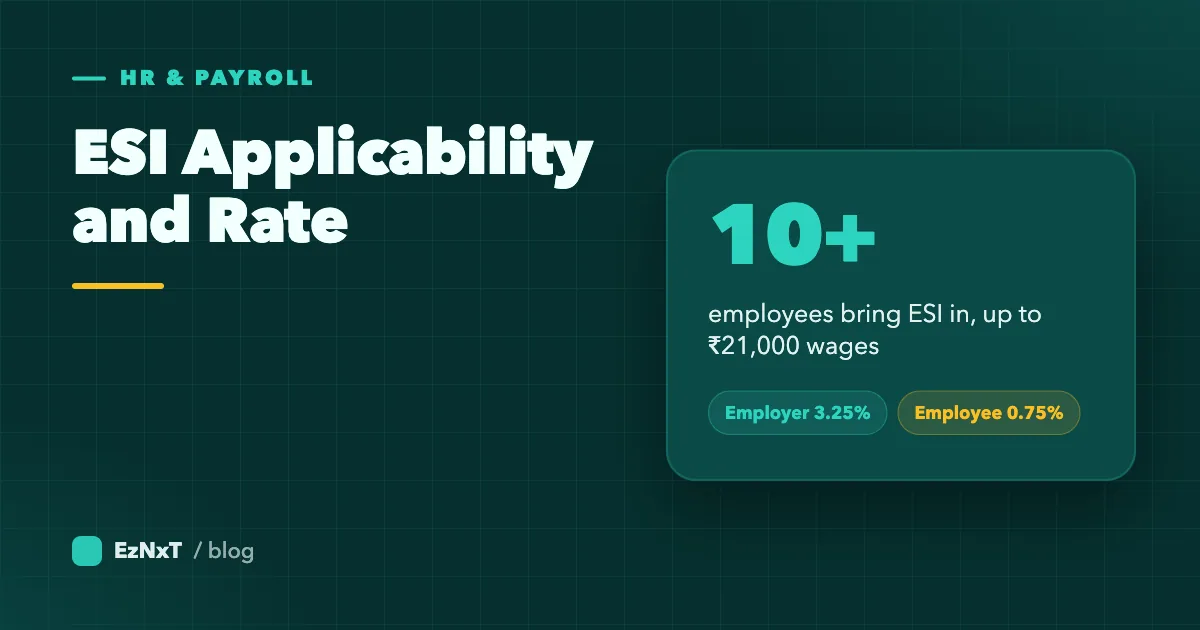
Quick answer: ESI applicability starts when a factory or notified establishment employs 10 or more people. Employees earning gross wages of up to ₹21,000 a month (₹25,000 for persons with disability) are covered. The employer contributes 3.25% and the employee 0.75% of gross wages, deposited by the 15th of the following month.
Employees’ State Insurance gives covered employees medical care and cash benefits during sickness, maternity and employment injury. For a small business it usually becomes applicable before PF, so it is worth setting up early.
ESI applicability for your business
The ESI Act applies to non-seasonal factories and to establishments notified by the government in each state: shops, hotels and restaurants, cinemas, road transport undertakings, newspaper establishments, and private educational and medical institutions, among others. In most notified areas the threshold is 10 or more employees.
- Count permanent, temporary and contract staff working in or for the establishment.
- Once covered, the establishment remains covered even if headcount later drops below the threshold.
- Register on the ESIC portal within the time allowed after becoming applicable, and register each eligible employee from their date of joining.
ESI applicability and rate for employees
| Item | Rule |
|---|---|
| Wage ceiling for coverage | Gross wages up to ₹21,000 a month (₹25,000 for persons with disability) |
| Employer contribution | 3.25% of gross wages |
| Employee contribution | 0.75% of gross wages |
| Low-wage exemption | Employees with average daily wages up to ₹176 do not pay their share; the employer still pays 3.25% |
| Due date | 15th of the following month |
Worked example: gross wages of ₹18,000
- Employee ESI: 0.75% × 18,000 = ₹135 (deducted from salary)
- Employer ESI: 3.25% × 18,000 = ₹585
- Total deposited: ₹720
An employee on ₹24,000 gross is above the ceiling, so no ESI applies, unless they were covered at the start of the current contribution period (see below).
Contribution periods: what happens when salary crosses ₹21,000
ESI works in two six-month contribution periods: 1 April to 30 September and 1 October to 31 March. Coverage is decided by wages at the start of the period. If a covered employee gets a raise above ₹21,000 mid-period, contributions continue until that contribution period ends, and the employee exits ESI from the next period.
ESIC has clarified that overtime is not used to decide whether an employee is covered, but contributions are payable on overtime wages paid to a covered employee. Keep attendance and overtime connected to payroll so the contribution base is right. See linking attendance to PF and ESI, and confirm current circulars on the ESIC portal.
ESI registration checklist
- Confirm your establishment type and location are notified under the ESI Act.
- Register the employer on the ESIC portal and receive the 17-digit employer code.
- Register each eligible employee and give them their IP (insured person) number.
- Deduct 0.75% from eligible employees’ wages every month and deposit with the employer’s 3.25% by the 15th.
- Keep monthly wage registers and challans for inspections.
For the PF side of compliance, read PF applicability.
Frequently Asked Questions
Is ESI applicable for fewer than 10 employees?
Generally no. ESI applies to notified establishments with 10 or more employees. Check whether your area and type of business are notified under the ESI Act.
What is the current ESI contribution rate?
The employer contributes 3.25% and the employee 0.75% of gross wages, a total of 4%. These rates have applied since 1 July 2019.
What is the ESI wage limit?
Employees with gross wages up to ₹21,000 a month are covered (₹25,000 for persons with disability). Above that, ESI does not apply from the next contribution period.
Is ESI calculated on basic or gross salary?
On gross wages: basic pay plus allowances paid in cash, including overtime payments to covered employees. Items such as the employer’s PF contribution and gratuity are excluded.
When is the ESI payment due?
By the 15th of the month following the wage month. For example, contributions on October wages are due by 15 November.
Planning a payroll cycle? Read how to run payroll in India, or see EzNxT payroll.